The Problem: Why Conventional Pig Farming Fails
Walk downwind of a conventional industrial pig farm, and you’ll understand why neighbors wage legal battles. The smell isn’t incidental — it’s a symptom of ecological dysfunction.
Most large pig operations rely on concrete floors and anaerobic lagoons. Pigs spend their lives on hard surfaces, surrounded by a stream of their own waste. This waste collects in vast open-air pits — essentially sewage treatment plants without the treatment. The anaerobic bacteria in these lagoons (bacteria that work without oxygen) break down manure, producing methane, hydrogen sulfide, and ammonia. These gases escape into the air. The liquid waste — contaminated with antibiotics, pharmaceuticals, nitrogen, and phosphorus — either seeps into groundwater or spills into waterways during storms.
The scale of the damage is hard to overstate. The EPA’s National Water Quality Inventory found that more than 600,000 miles of assessed rivers and streams are impaired, with agricultural runoff — including animal feeding operations — among the leading sources. Toxic ammonia and nitrate seepage threatens drinking water supplies. A peer-reviewed study of communities near large hog operations in North Carolina found elevated rates of respiratory symptoms, gastrointestinal problems, and significantly reduced quality of life — residents reported they couldn’t open their windows or go outside even in nice weather (Wing & Wolf, 2000). The animals themselves spend their lives in conditions that demand continuous antibiotic treatment to prevent disease.
This is the industrialized pig farming system that dominates North America — but there’s a better way.
Korean Natural Farming and the Deep Litter System
Korean Natural Farming (KNF) — a biological approach to agriculture that replaces synthetic chemicals with locally collected microorganisms and fermented plant inputs — produced one of its most visible applications in the piggery. Korean farmer-researchers noticed that certain pig operations produced no smell despite housing dozens of animals in close proximity. They identified the key variables and developed what’s now called the Inoculated Deep Litter System (IDLS).
The idea inverts conventional thinking. Instead of concrete floors and waste lagoons, IDLS uses a living, self-composting bedding system where pigs stand on a 2–3 foot deep bed of wood chips, sawdust, and biochar, all inoculated with naturally occurring microorganisms. The result: a pen that requires no daily cleaning, produces no offensive odor, generates no wastewater runoff, and over decades transforms itself into rich garden soil — all without chemical inputs. In 2006–2012, researchers at the University of Hawaii’s College of Tropical Agriculture and Human Resources (CTAHR) tested IDLS in Hawaiian conditions and found it consistently eliminated odor while improving animal welfare and reducing disease.
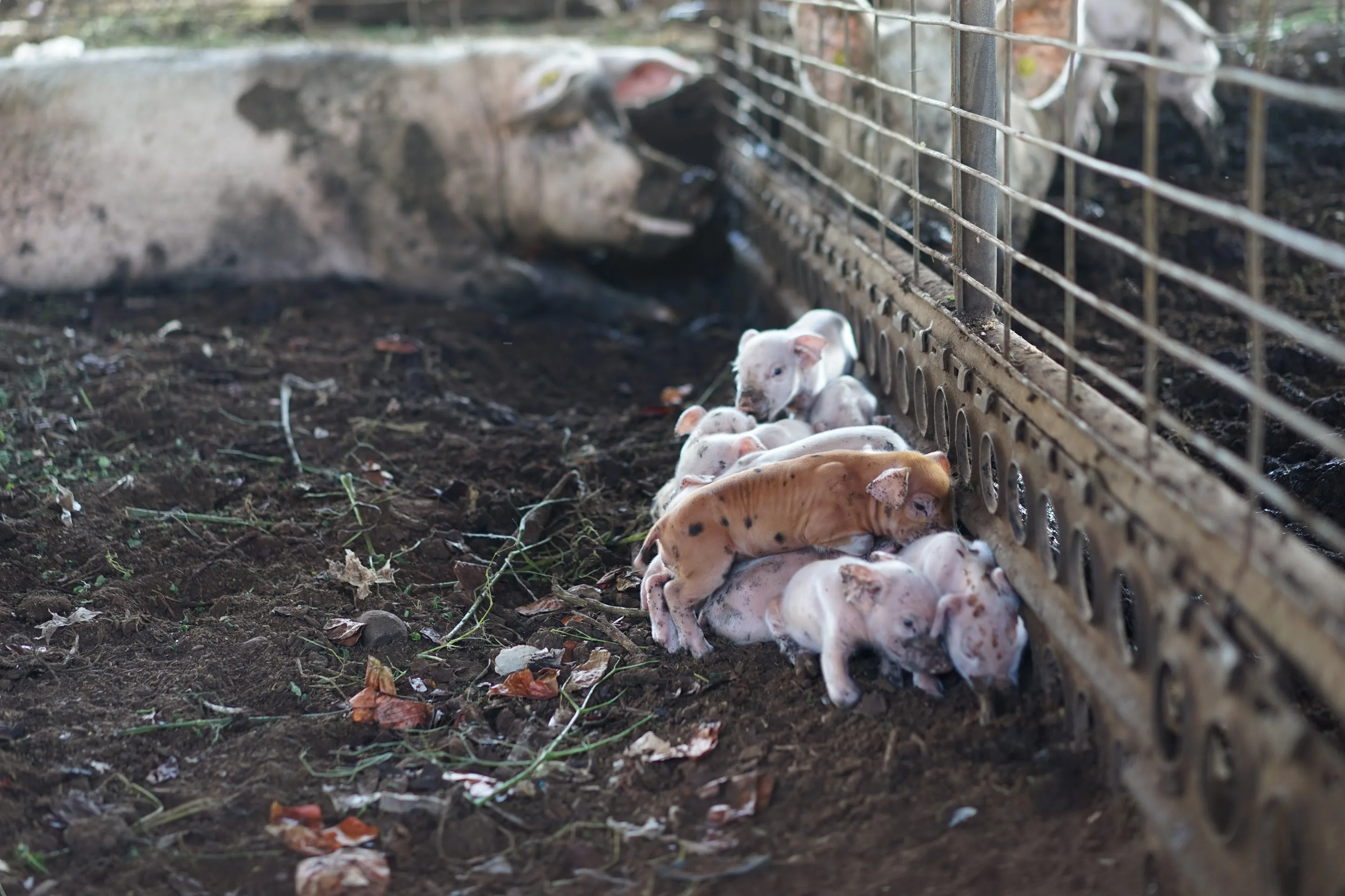
On November 15, 2012, the Natural Resources Conservation Service (NRCS) officially recognized IDLS as a cost-sharable Best Management Practice (BMP) for swine operations — a federal stamp of approval that the science is sound and the system meets EPA regulations. Despite that recognition, adoption has been slow. Most pig farmers in the U.S. still use conventional concrete-and-lagoon systems. Mountain View Farms is one of Hawaii’s largest KNF piggery operations, and one of a small number of farms anywhere applying this system at scale.
The Three Principles Behind the System
The deep litter system’s power rests on three pillars of microbiology and soil science. Understanding them makes the rest of the article click.
Aerobic decomposition. When oxygen is available, microbes produce CO₂ and water — not toxic gases. This is the fundamental chemistry that prevents odor. It’s the same process that happens when leaves decompose on a forest floor, and the reason a compost pile doesn’t smell like a landfill.
Indigenous microorganisms. Rather than buying laboratory cultures, KNF practitioners collect microbes from the local forest floor — organisms already adapted to the climate, soil, and ecosystem where the farm operates. These local microbes establish themselves faster and outcompete pathogens more effectively than imported strains. The IMO method’s four-stage expansion (IMO-1 through IMO-4) starts with a single shoebox of forest-inoculated rice and produces enough inoculum to establish biology for dozens of pens.
Soil food web restoration. Over years of continuous microbial action, the deep litter becomes a living ecosystem. Bacteria, fungi, protozoa, and beneficial organisms form a network that breaks down organic matter, cycles nutrients, and builds soil structure. This isn’t passive decomposition — it’s active soil creation.
None of these concepts are new. Composting has been practiced for millennia. Fermentation is the basis of human food culture. Soil building is the foundation of regenerative agriculture. The IDLS simply applies these proven principles to animal husbandry at scale.
How the System Works: The Biology
The Physical Structure
The IDLS pen is built in layers, creating a microhabitat:
MIDDLE: Logs and branches (12–18 in.) — air channels and slow carbon
BOTTOM: Biochar (6–12 in.) — moisture absorption and microbial habitat
GROUND: Compacted earth or concrete — foundation
All layers are inoculated with IMO-4 (Indigenous Microorganisms at the fourth expansion stage) during setup. An initial misting of LAB (Lactic Acid Bacteria) and FPJ (Fermented Plant Juice) activates the dormant microbial community.
Unlike monocultures of bacteria grown in laboratories, IMOs are locally collected from the forest floor near the farm. This matters immensely: the microbes have already evolved to thrive in your climate, soil, and environment. They arrive pre-adapted to establish themselves and outcompete pathogens.
The Decomposition Process
When a pig deposits manure and urine into the litter:
- Absorption: The carbonaceous bedding immediately absorbs moisture from the waste.
- Inoculation: IMO and LAB microbes in the bedding multiply and begin breaking down organic matter.
- Aerobic decomposition: The porous structure of wood chips and logs allows oxygen to penetrate. The microbes that thrive in these aerobic conditions produce CO₂ and water as waste products — not foul gases.
- Heat generation: The metabolic activity of billions of microbes generates gentle heat (reaching 55–65°C in the composting zone), which further drives off moisture and keeps the system aerobic.
- Natural aeration: As pigs root through the litter (their instinctive behavior), they physically turn and aerate the bedding, further supporting the aerobic process.
- Continuous conversion: Manure is converted into humus-like material in place, continuously.
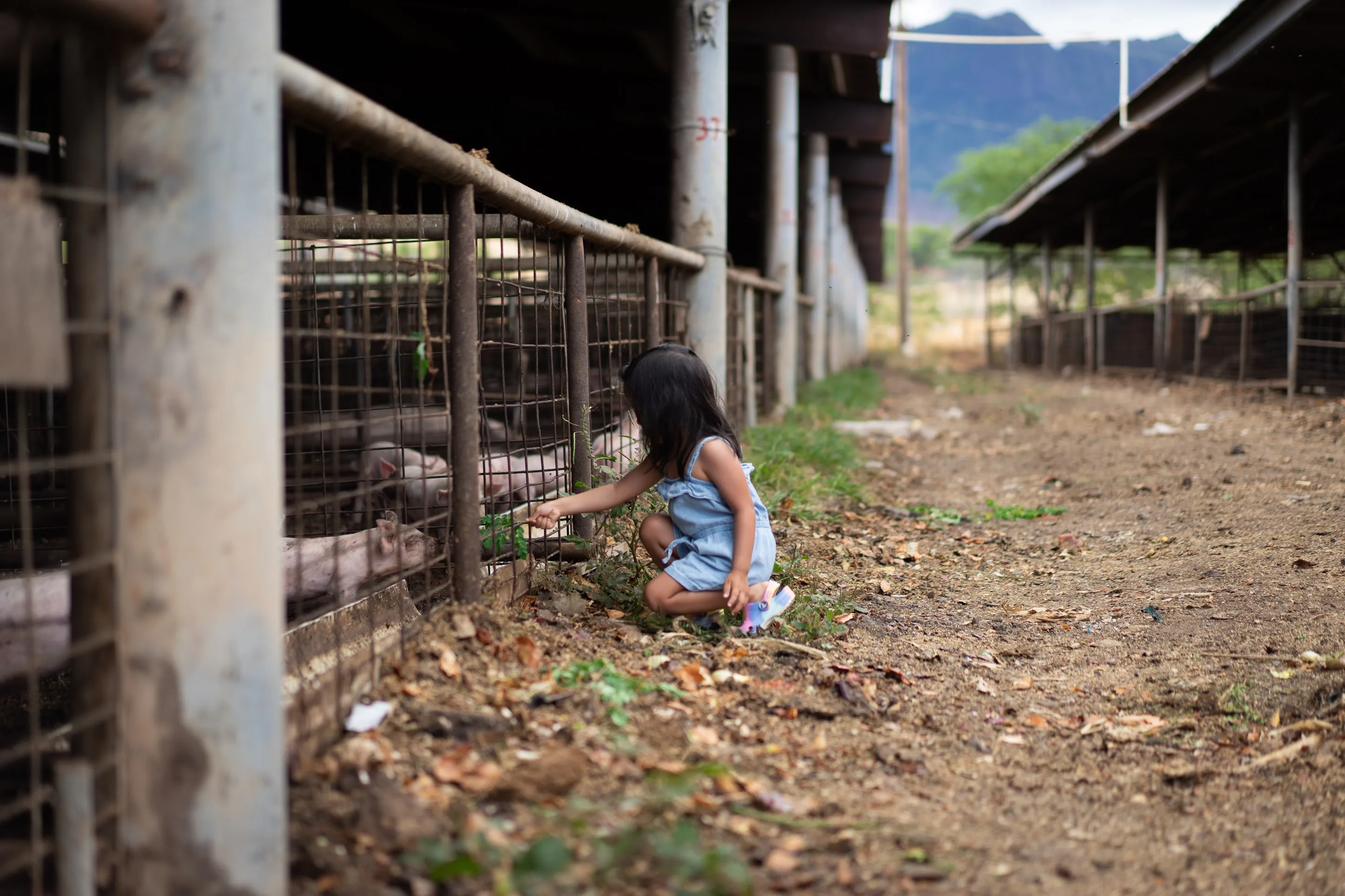
The pen’s natural ventilation — through open sides or mesh panels, positioned to catch prevailing winds — ensures air circulation. Unlike conventional barns with mechanical ventilation systems, the IDLS pen simply breathes. Because the biology is working correctly, no special engineering is needed.
Why There’s No Odor: Aerobic vs. Anaerobic
The stench of conventional pig farms comes from anaerobic decomposition — the breakdown of organic matter without adequate oxygen. Anaerobic bacteria produce hydrogen sulfide (rotten egg smell), ammonia (pungent and toxic), and volatile organic compounds (VOCs). These gases are toxic to both pigs and neighbors.
The IDLS works by preventing anaerobic conditions from ever developing. The porous bedding, the constant microbial heat, the pigs’ rooting behavior, and the pen’s open design all maintain oxygen availability. When oxygen is present, different bacteria dominate. Aerobic decomposition produces CO₂ and water — the same products you get when composting garden waste or leaves in a forest. The result: the pen smells like a forest floor after rain, not like sewage.
This is not speculation. Studies of pig manure composting with IMOs show final compost temperatures between 55–65°C, with aerobic layers maintaining active decomposition. CO₂ emissions indicate complete oxidation of organic matter — the mark of aerobic systems.
Animal Welfare
The contrast with conventional pig farming is stark. Pigs are evolved to root and forage — it’s one of their strongest instinctive behaviors. Concrete floors make that impossible. An IDLS bed of wood chips and sawdust gives them a surface they can actually dig into, which is both physically and psychologically enriching.
Respiratory health improves dramatically. Ammonia from anaerobic lagoons is a respiratory toxin, and pigs in conventional operations often develop chronic lung damage. In an IDLS pen, there’s no ammonia buildup — the animals breathe clean air. That reduction in respiratory and chemical stress means IDLS pigs don’t require the continuous antibiotic treatment that conventional operations depend on. Our animals at Mountain View Farms receive no antibiotics, no vaccinations, and no chemical growth promoters.
Even something as simple as bedding matters. Soft litter supports natural posture and reduces joint stress compared to hard concrete — think about the difference between standing on a forest floor versus a parking lot, all day, every day.
These welfare benefits translate to measurable outcomes. Research shows that pigs raised in deep-litter systems achieve equal or superior daily weight gain, feed conversion ratios, and survival rates compared to conventional concrete-floor operations — while living stress-free lives.
The Long-Term Transformation: Soil Building
This is where IDLS reveals its deepest purpose. After 25–30 years of continuous use, the deep litter has been transformed through microbial action into something remarkable: forest-floor-quality soil — dark, rich, humus-filled, and biologically alive.
This is not a metaphor. The animals are not being moved; the pen is not cleaned out. Over decades, the combination of manure input and continuous aerobic decomposition creates a soil amendment that becomes more valuable with each year.
Think about the math: an 800-pig operation processes hundreds of tons of manure and urine annually. Over 25 years, that’s thousands of tons of waste that would conventionally be disposed of, transported, and managed as a pollution liability. Instead, it becomes a soil fertility asset — rich, living soil worth real money in agricultural markets.
This is regenerative agriculture at its most literal: animals directly build the soil they live on, creating a self-sustaining cycle that improves land, not degrades it.
The Science Behind the System
The legitimacy of IDLS doesn’t rest on our word alone. The University of Hawaii’s College of Tropical Agriculture and Human Resources (CTAHR) conducted six years of foundational research documenting odor elimination, waste conversion, and manure decomposition rates. Those studies became the scientific basis for the NRCS’s 2012 decision to recognize IDLS as an official Best Management Practice — meaning it meets federal standards for waste management and qualifies for cost-share support.
Hawaii, with its small-farm culture and strict environmental regulations, was the ideal proving ground. The first large-scale IDLS piggery went operational in August 2009 in Kurtistown on the Big Island. Since then, the system has gained a foothold in Hawaii and begun spreading internationally. But it remains rare. The conventional concrete-and-lagoon model is deeply entrenched — in regulations, infrastructure, and farmer training. Most extension agents aren’t taught microbial ecology. Most farmers have never seen an alternative.
That’s part of why we think what we’re doing matters. When you buy pork raised on a deep litter system, you’re supporting a model that the science validates but the industry hasn’t caught up to yet.
Mountain View Farms: What This Looks Like in Practice
As one of Hawaii’s largest KNF piggery operations, we raise roughly 800 pigs on an inoculated deep litter system in Waianae Valley on Oahu. The system makes possible an approach to animal husbandry that would be unthinkable in conventional farming.
Our animals receive no antibiotics — because ammonia stress and chronic respiratory exposure are eliminated, antibiotics simply aren’t needed. No vaccinations, because healthier animals in less-stressed conditions maintain stronger natural immunity. No hormones. Their diet is based on locally sourced agricultural byproducts, food scraps, and fermented plant matter — no meat byproducts or rendered animal proteins.
But the pigs are only part of the picture. The deep litter system means our operation is feeding soil biology, not just animals. Every year the pens run, the litter beneath them becomes richer and more alive. We’re building Waianae Valley’s fertility one generation at a time.
The farm sits in a valley traditionally used for agriculture, on Hawaii’s leeward coast. We see it as a model for what modern food production can look like: productive, profitable, and ecologically healing rather than extractive.
Addressing Skepticism: “This Sounds Impossible”
Skepticism is warranted when something sounds too good to be true. Here’s what addresses the most common doubts:
“Won’t it smell after a few months?”
Only if aerobic conditions collapse. This happens when the system is overcrowded (too many pigs compressing the litter), when carbon material is depleted and not replenished, when drainage is poor, or when the pen has no ventilation. All of these are management choices, not physics failures. We’ve been running our system for years, and the science — confirmed by CTAHR research and NRCS recognition — backs it up.
“How does it stay aerobic if pigs live directly on it?”
Animal activity is not the problem — it’s part of the solution. Pigs naturally root, which physically turns the litter and introduces oxygen. The porous structure (wood chips, logs, biochar) creates air channels. The pen’s open design allows wind to flow through. Microbial metabolism generates heat that drives off moisture. All of these factors work together to maintain aerobic conditions. It’s a system, not a single mechanism.
“What about disease and pathogen accumulation?”
This is where the microbes matter. The aerobic-adapted microbial community (IMOs) actively competes against pathogenic bacteria. LAB (Lactic Acid Bacteria) produce organic acids that suppress pathogens. The slightly acidic pH makes the environment hostile to most pathogens. This is not speculation — it’s applied microbiology, used in human food fermentation for thousands of years. The difference is that instead of fermenting cabbage, you’re fermenting pig manure under controlled conditions.
“Why don’t conventional farms use this if it works?”
Several reasons: (1) Inertia — the concrete-and-lagoon system is established in regulations and infrastructure; (2) Hidden costs — conventional farming’s expenses (manure transport, disposal, pollution liability, antibiotic treatment) are externalized or absorbed; (3) Knowledge gap — most farmers and extension agents aren’t trained in microbial ecology; (4) Scale mismatch — IDLS works brilliantly for 100–1,000 pigs but requires different design at 10,000+ animal operations. As regulations tighten and farmers experience cost-share incentives, adoption accelerates.
Why This Matters Beyond Our Farm
What makes the deep litter system revolutionary isn’t any single benefit — it’s that it solves multiple problems at once. Environmentally, there’s no water contamination, no ammonia emissions, no lagoon pollution. For animal welfare, it means natural behavior, no antibiotics, less stress, healthier animals. For farmers, it means reduced labor (no daily cleaning), reduced disposal costs, and a valuable end product in the form of forest-floor-quality soil.
The federal government has recognized it. The science supports it. And yet the vast majority of pork in this country is still raised on concrete floors over waste lagoons. We think that will change — but for now, when you see pork raised on an inoculated deep litter system, you’re looking at something genuinely different from what’s on most shelves.
A Different Way Forward
The conventional pig farming model — animals on concrete, waste in lagoons, odor across the landscape, antibiotics in the feed — is not inevitable. It’s a choice, one made when the alternatives weren’t understood or available.
The Inoculated Deep Litter System proves that a different model works: animals on living bedding, waste converted to soil, odor eliminated, antibiotics unnecessary. It works at scale, it’s officially recognized (NRCS BMP), it’s profitable (no cleaning labor, valuable end product), and it regenerates land rather than extracting from it.
Our roughly 800 pigs in Waianae Valley demonstrate what this future looks like. No chemicals, no odor, no wastewater runoff — just biology doing what it does best: turning death into life, manure into soil, and animals into a regenerative force on the land.
Sources
Peer-Reviewed & Government
- DuPonte, M.W. & Fischer, D. (2012). The Natural Farming Concept: A New Economical Waste Management System for Small Family Swine Farms in Hawai‘i — CTAHR LM-23
- Wing, S. & Wolf, S. (2000). Intensive Livestock Operations, Health, and Quality of Life among Eastern North Carolina Residents — Environmental Health Perspectives 108(3):233–238
- Donham, K.J. (1989). Association of environmental air contaminants with disease and productivity in swine — American Journal of Veterinary Research 52(10):1723–1730
- Honeyman, M.S. (2005). Extensive bedded indoor and outdoor pig production systems in USA — Livestock Production Science 94:15–24
- EPA (2017). National Water Quality Inventory: Report to Congress — EPA 841-R-16-011
- Aerobic Composting of Pig Excreta with Indigenous Microorganisms — ResearchGate
- From Pollution to Resource: Advancing Swine Waste Treatment — Frontiers in Sustainable Food Systems (2024)