First, the Thing Nobody Tells You About Plant Oils
When you buy a bottle of cold-pressed olive oil, you're buying something with a built-in clock. Plant oils don't all go bad at the same pace. Some survive years in sealed jars. Others turn rancid on the shelf in months. The difference comes down to chemistry — specifically, how many fragile double bonds the oil contains, and how much vitamin E the seed packed in alongside them.
Moringa seed oil — the oil we cold-press from our Waianae-grown moringa seeds — sits at the remarkably stable end of that spectrum. That stability is why ancient Egyptians sealed it in jars and left it in royal tombs. It's why Greek and Roman perfumers used it to hold their scents. It's why a watchmaker in 19th-century Cairo could lubricate a pocket watch with it.
And it's still why, when you open one of our bottles six months after we pressed it, it smells and tastes the same as the day it came out of the press.
This article is a closer look at that oil — its three-thousand-four-hundred-year paper trail, what peer-reviewed chemistry has since confirmed about why it works, and what the evidence does and doesn't support about using it on (and in) your body. Same honest-tier framework we used in our moringa leaf article: Strong, Promising, Early-stage, Hopeful.
A 3,400-Year Track Record
A Royal Oil in Egypt
Moringa seed oil is old. Older than recorded history for most of what we put on our skin today. Long before Cleopatra, before olive oil became the default of the Mediterranean, there was already an oil pressed from moringa seeds in Egypt. The Egyptians called it b3k (pronounced bak), and modern Egyptologists identify it as ben oil from the moringa tree (Kondo, 1991). It was mistaken for olive oil for a long time — scholars eventually worked out that the Egyptian word for olive was something else entirely.
The earliest mention shows up in The Story of Sinuhe, a Twelfth Dynasty Egyptian tale from around 1900 BCE. The hero, exiled abroad, describes the foreign land that took him in: "It was a good land, Yaa was its name. Figs were there as well as grapes, and wine was more plentiful than water. The land abounded with honey and ben-oil." The way he writes it — honey and ben-oil, side by side — tells you what category the oil belonged to. Precious. Worth listing.
Across Egyptian history, ben oil keeps showing up in that company. When Pharaoh Tuthmosis III came back from Syria in 1450 BCE, his scribe inventoried the haul alongside the ben oil: slaves, horses, silver dishes, lapis lazuli, jars of honey and wine. A century later, in Amenhotep III's palace at Malkata, archaeologists recovered roughly 1,400 jar labels — twenty-two of them named ben oil specifically, alongside other labels for moringa seeds grown in the royal orchard at Memphis. The highest-grade oil came from a place called Salhi, in northern Syria; Amenhotep's tomb held a wooden tag identifying it as "ben-oil, the best of His Majesty."
Ben oil also made its way into Egyptian medicine. The Ebers Papyrus — one of the oldest medical texts in human history — prescribes a remedy for stomach trouble made by boiling moringa oil with honey, frankincense, and wine. It was also used as an anti-inflammatory rub, an enema, and an insect repellent.
One caveat worth naming: people sometimes claim moringa oil was used in Egyptian mummification. We haven't seen a primary source for that. What Egyptology does establish is that ben oil was used for anointing, offerings, perfume, and medicine — not as an embalming fluid.
The Perfumer's Workshop in Greece and Rome
The oil traveled. By the 1st century CE it had spread into the Greek and Roman world — not as a curiosity, but as the perfume-maker's working oil. Theophrastus, Aristotle's student and effectively the father of botany, wrote about it as a preferred base for perfumes. Dioscorides — the Greek physician whose pharmacopoeia stayed in medical use for 1,500 years — described the source tree by a name that translates to "the nut of the perfumers," noting that the ground kernels produced an oil used in place of olive to prepare precious ointments. Pliny the Elder, writing not long after, called the tree myrobalanum — from the Greek myron, meaning ointment.
By Pliny's time, Alexandria was the perfume capital of the Mediterranean, and moringa oil was the carrier of choice for the finest blends made there. The reason was practical: perfume is expensive to make, and a perfume whose base oil turns rancid under its scent notes is a disaster. You'd rather pay a premium for an oil that holds your blend for a year. Moringa did. When Arabs conquered Alexandria in 642 CE, they inherited the industry — and the oil.
Beyond Perfume: Clockmakers and Kitchens
That same property — refusing to spoil — gave ben oil a long second life in places you might not expect. Nineteenth-century Cairo had a working trade where Bedouin merchants supplied moringa seeds specifically to clockmakers (Britannica). Ben oil was prized as a lubricant for fine mechanical movements because it didn't gum up over time. A pocket watch oiled with ben oil could run for years without service.
And in parts of Sudan, Egypt, and the Horn of Africa, moringa oil never really left the kitchen. It's an edible cooking oil — high in oleic acid like olive oil, with a mild nutty flavor and a frying stability that lets it stand up to heat. Our oil is food-grade too: a spoonful on a salad, a drizzle over grilled vegetables, a bit of cooking over moderate heat all work just fine.
Through all of it, the throughline is the same. Ben oil persisted across cultures and millennia for two reasons: it didn't spoil, and people came to believe it healed.
Why It Doesn't Go Rancid
Here's where the ancient preference meets modern chemistry.
Plant oils spoil when oxygen attacks their fragile bonds. The more fragile bonds an oil has, and the less protection it carries, the faster it goes off. Different oils sit in very different places on that spectrum. Flax and hemp oils are mostly the fragile kind — you have to keep them in the fridge and use them within weeks. Olive oil is mostly the sturdy kind, which is why a sealed bottle on your counter lasts a year. Moringa oil sits even further along that spectrum than olive.
Two independent studies — one on Kenyan seeds, one on Pakistani — analyzed cold-pressed moringa oil and came back with the same picture (Tsaknis et al., 1999; Anwar & Bhanger, 2003): about three-quarters of the oil is oleic acid — the same sturdy fat that makes olive oil last. Less than one percent of the oil is the fragile, polyunsaturated kind. And there's another fat in moringa, called behenic acid, that's unusual in plant oils. The behenic content is actually where the oil gets its other name — ben oil, or behen oil.
- Oleic acid (the sturdy fat in olive oil): ~70–78%
- Behenic acid (unusual long-chain fat, where moringa gets its name): ~5–7%
- Palmitic and stearic acids (other sturdy fats): ~10–13%
- Polyunsaturated fats (the fragile kind): under 3%
On top of that, the seed packs its own defense system. Moringa oil is unusually rich in vitamin E — about 120–160 mg per kilogram of oil, well above most cooking oils — plus a couple of related vitamin-E variants and plant-derived sterols. (For the chemistry-curious: that's α-tocopherol as the main form, with γ- and δ-tocopherols and sterols like β-sitosterol and stigmasterol filling out the picture.) Their job is the same as a chemical bodyguard: when oxygen radicals try to attack the oil, these molecules step in and absorb the hit, sparing the rest of the oil.
When researchers actually measure oxidative stability in the lab — using a method called Rancimat that simulates aging under heat and air — moringa oil holds its own with extra-virgin olive oil, and in several studies outperforms it. In one head-to-head, cold-pressed moringa oil from Kenya lasted more than nine times as long as the olive-oil control before showing signs of breakdown.
The ancients didn't run Rancimat assays. They just noticed, across centuries, that ben oil kept when other oils didn't. The chemistry explains the track record.
What Moringa Oil Does for Skin: Honest Evidence Tiers
Here we shift from composition to use. Can moringa oil actually do something for your skin — beyond just feeling nice? The evidence breaks into tiers.
Anti-Inflammatory Action — Without the Steroid Side Effects
Calming inflamed, reactive skin — the redness and swelling that flare up when something triggers them — is one of moringa oil's most consistent traditional uses. It's also where modern research has caught up the most.
The most rigorous study we've found is Cretella et al., 2020, published in the Journal of Ethnopharmacology. Researchers applied moringa seed oil topically to mice in three different skin-inflammation models — TPA (a standard inflammation trigger), arachidonic acid, and phenol — and measured ear edema, neutrophil infiltration, and epidermal hypertrophy.
Moringa oil reduced inflammation across all three models. More interesting: when they tested it against dexamethasone (a potent topical steroid), moringa oil achieved comparable anti-inflammatory effect through a similar mechanism — activation of the glucocorticoid receptor — without the skin atrophy that steroid creams are notorious for. In the authors' words, moringa oil "did not present any influence on skin thickness."
Their conclusion: moringa oil is "effective as a treatment for skin diseases that rely on keratinocyte hyperproliferation" — a mechanism relevant to conditions like psoriasis — without the adverse effects of dexamethasone. That's a meaningful result. It's also still a mouse study. We think it's promising evidence, not proof, and we'd want to see human trials before positioning moringa oil as a treatment for any specific skin disease.
Skin Hydration in Humans
Almost every plant oil sold for skincare claims to moisturize — to keep skin soft, supple, and less prone to flaking or tightness. For moringa, there's actually human data behind the claim.
A 32-person human study by Athikomkulchai et al., 2021, published in Cosmetics, formulated a moringa seed oil cream and measured skin hydration changes over four weeks. Twice-daily application increased skin hydration by 16% at week 1, 76% at week 2, 77% at week 3, and 85% at week 4, compared to the cream base alone. No skin irritation was reported.
Thirty-two people isn't a definitive clinical trial — but the effect is large, consistent, and in humans. The authors concluded that the formulation was "appropriate for pharmaceutical and cosmetic uses."
Hair and Scalp
You'll see hair-growth claims in a lot of moringa-oil marketing. The actual research is thin. We haven't seen a human randomized trial. There's a single rabbit DHT-alopecia study suggesting dose-dependent regrowth, but extrapolating from that to human scalps is a bridge too far for us.
What moringa oil is — a rich, non-drying, non-rancid oil you can massage into your scalp and hair — is a good nourishing conditioner. What it isn't, at least as far as the human evidence goes, is a hair-regrowth treatment.
Traditional and Anecdotal Uses
This section is a different tier. People have used moringa oil for centuries in ways the science hasn't caught up to. We include them because customers ask, because we hear our own remarkable stories from the people who use it, and because we'd rather acknowledge a long tradition than pretend it doesn't exist.
Taken Orally for Sore Throat, Cough, and Cold-Sore Soothing
A spoonful of moringa oil is a traditional remedy for a sore throat, a cough, or the early prickle of a cold sore. The practice runs across Ayurvedic, Sudanese, and East African folk medicine. The oil is food-grade, gentle on the throat, and stays good in the bottle long enough that it survived as a folk remedy in places where less stable oils didn't.
On Sunburns, Oil Burns, and Cuts
We hear this one a lot from chefs at the restaurants we supply — a few drops of moringa oil on a fresh oil burn or a knife cut. Customers describe using it the same way on sunburns and minor scrapes. The vitamin E content and the documented anti-inflammatory action (above) make it a defensible choice for soothing irritated, healing skin.
As a Massage Oil and Topical Self-Care
Traditional applications on joints, temples, and scalp go back centuries. The composition — high oleic, high vitamin E, gentle on skin — makes moringa oil a defensible carrier oil for massage. The peer-reviewed topical evidence supports general anti-inflammatory activity. Whether that translates to specific folk uses — easing tension headaches, soothing muscle soreness — is in "no studies, lots of tradition" territory.
We're not claiming moringa oil is a proven treatment for any of these. We're saying people have used it this way for centuries, and we'd rather acknowledge that than pretend the history and the stories we hear don't exist.
From Seed to Bottle: Our Oil
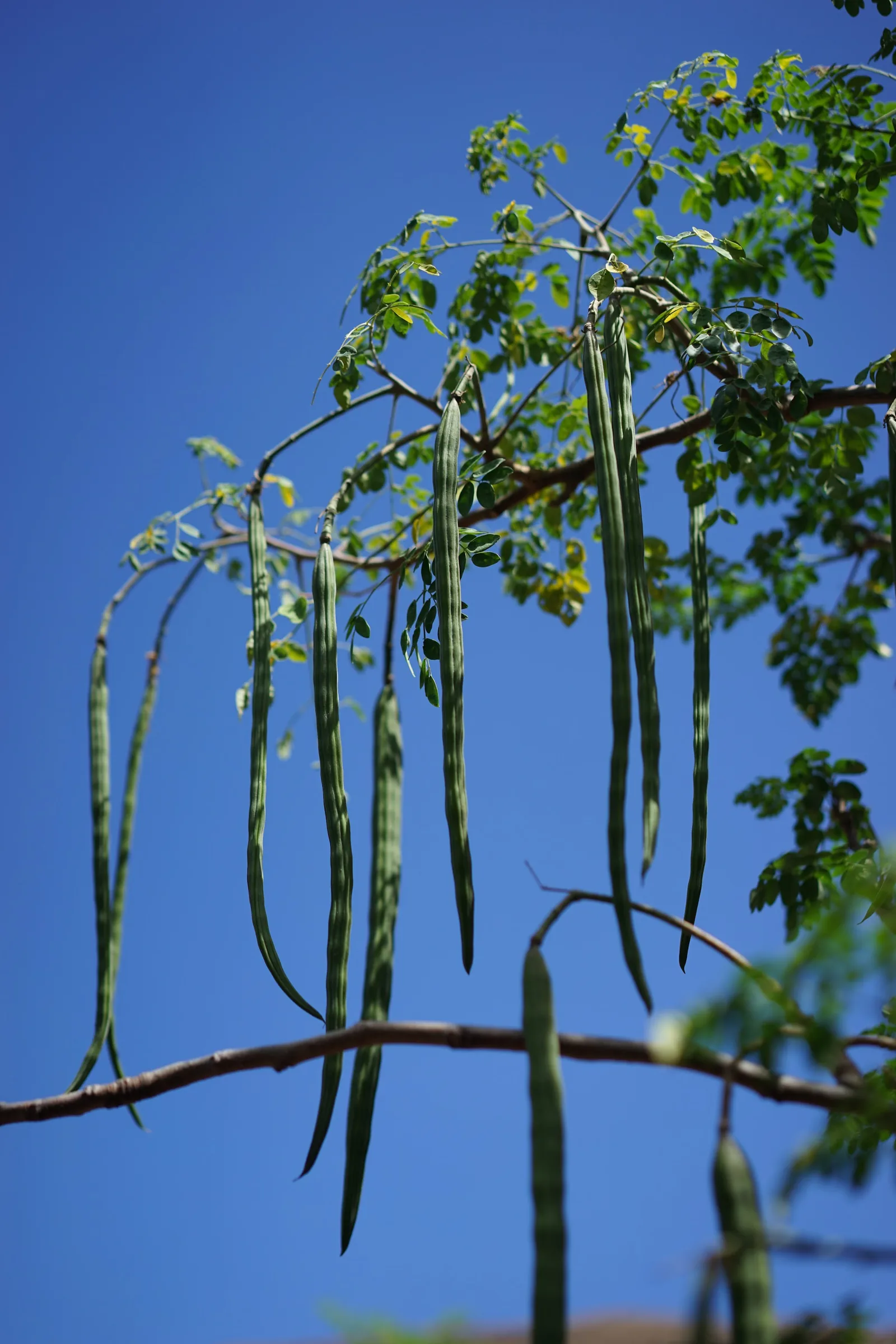
Our moringa seeds come from the same trees we grow for leaf powder — Korean Natural Farming-managed soil, no pesticides, no synthetic fertilizers, no commercial herbicides. The trees flower and fruit in Waianae Valley's dry warm climate nearly year-round. Seeds ripen in long three-sided pods that dry on the tree.
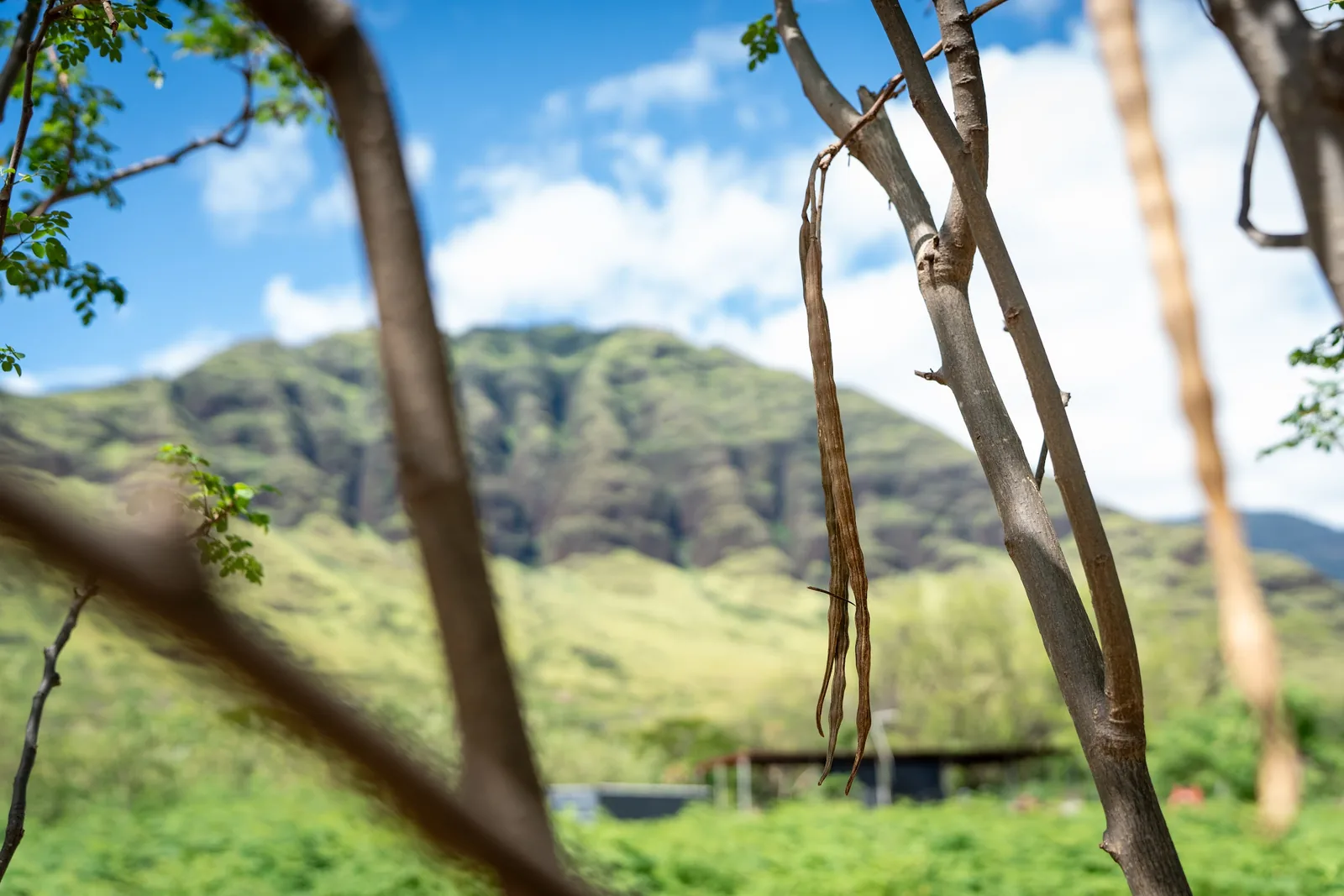
We harvest mature pods, crack them by hand, and select the most uniform seeds for pressing.
"Cold-pressed" isn't marketing language — it's a process constraint. Heat is what degrades the tocopherols, alters the fatty-acid profile, and compromises the oxidative stability that makes moringa oil what it is. We press at temperatures low enough to preserve all three. That means slower throughput and lower yields than an industrial hot-press operation — the same trade-off we make on the leaf side, where we indoor-shade-dry at low temperature. The research tells us it's worth it.
After pressing, the oil is filtered without chemical refining and bottled in small batches. That's the whole process. The oil that comes out the other end is, chemically and nutritionally, the same oil the Egyptians sealed in jars — and the same oil the studies in this article tested.
For more on how we farm, see our article on Korean Natural Farming and the Our Method page.
How to Use Moringa Oil
The Short Version
Moringa oil has a 3,400-year track record. It was the perfume-carrier of pharaonic Egypt, the cosmetic base of Alexandria, and the watchmakers' oil of 19th-century Cairo, because it didn't spoil. Modern peer-reviewed chemistry explains why: ~70–78% oleic acid, ~5–7% behenic acid, under 1% polyunsaturated, plus protective tocopherols — a combination that produces oxidative stability rivaling extra-virgin olive oil.
For skin, the peer-reviewed evidence is promising: real anti-inflammatory activity in animal models (through a steroid-like mechanism but without steroid-like side effects), and measurable human skin-hydration gains in a small human study. For hair and scalp, it's a good conditioning oil; the regrowth claims you see in marketing aren't backed by human research. And the traditional and anecdotal uses — oral for sore throat and cough, topical for joints and temples — we mention because people ask, not because the research supports them.
If you're considering moringa oil, the questions worth asking are the same ones that apply to the leaf: Was it grown naturally — without synthetic fertilizer or pesticides? Was it processed gently — cold-pressed, not heat-extracted? Is it pure seed oil, without blenders or fillers?
That's what we built our oil operation around. KNF-grown in living soil, cold-pressed in small batches. Same answers we'd want if we were the customer.
Sources
History
- Kondo, J. (1991). Ben-Oil in Ancient Egypt. Orient 27: 44–55.
- Theophrastus, On Odours (LacusCurtius, Loeb Classical Library)
- Dioscorides, De Materia Medica IV.157 (Beck translation, Olms-Weidmann, 2005 / 2017 revised).
- Pliny the Elder, Natural History XII.46 Myrobalanum (Rackham translation, Loeb Classical Library Volume IV, 1945).
- "Ben oil" — Encyclopædia Britannica
Composition & Oxidative Stability
- Tsaknis, J., Lalas, S., Gergis, V., Dourtoglou, V., & Spiliotis, V. (1999). Characterization of Moringa oleifera Variety Mbololo Seed Oil of Kenya. J. Agric. Food Chem. 47(11): 4495–4499.
- Anwar, F., & Bhanger, M.I. (2003). Analytical Characterization of Moringa oleifera Seed Oil Grown in Temperate Regions of Pakistan. J. Agric. Food Chem. 51(22): 6558–6563.
Topical Skin Evidence
- Cretella, A.B.M. et al. (2020). Expanding the anti-inflammatory potential of Moringa oleifera: topical effect of seed oil on skin inflammation and hyperproliferation. J. Ethnopharmacol. 254: 112708.
- Athikomkulchai, S. et al. (2021). Moringa oleifera Seed Oil Formulation Physical Stability and Chemical Constituents for Enhancing Skin Hydration and Antioxidant Activity. Cosmetics 8(1): 2.